Attendee List
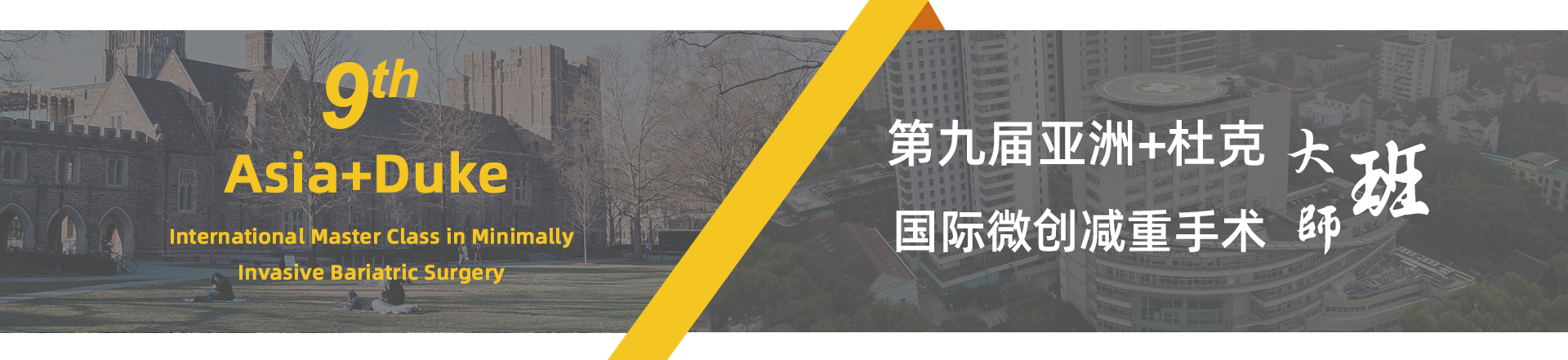
2026 Apr 21-25th, Shanghai, China
| Time | Items | Speaker |
|---|---|---|
| 08:30-08:40 | Openning Address | Co-Chairs |
| Session 1. Surgical Technique Optimization | ||
| 08:40-09:00 | How to minimize SG complications? | Charles Peng Zhang |
| 09:00-09:20 | How to minimize gastric bypass complications? | Huiliang |
| 09:20-09:40 | Utilization of DS | Ranjan Sudan |
| 09:40-10:00 | Surgery in extreme obesity: pitfalls and pearls | Yan Gu |
| 10:00-10:30 | Q&A and group discussion | |
| 10:30-10:40 | Tea Break | |
| Session 2. Management of Surgical Complications | ||
| 10:40-11:00 | GI leak: early diagnosis and management | Jiangfan Zhu |
| 11:00-11:20 | Management approach to postoperative hemorrhage | Yong Wang |
| 11:20-11:40 | Treatment of post-operative GI stenosis | Nengwei Zhang |
| 11:40-12:00 | Management of post-operative GERD and intra-thoracic sleeve migration | Qiyuan Yao |
| 12:00-12:30 | Q&A and group discussion | |
| 12:30–13:00 | 🍽 Lunch Break | |
| 13:00 | Session 3. Surgical Outcome Optimization | |
| 13:00-13:20 | Prediction and optimization of post-operative T2D outcome | Shaihong Zhu |
| 13:20-13:40 | Management of post-operative weight loss insufficiency and weight regain | Luis Osvaldo Suarez Carreon |
| 13:40-14:00 | Rethink iron deficiency after MBS: experimental findings | Yikai Shao |
| 14:00-14:20 | Transoral outlet reduction for the treatment of dumping syndrome | Mathew Ross Hannington |
| 14:20-14:50 | Q&A and group discussion | |
| 14:50-15:00 | Certificate | |
| 15:00-15:10 | Adjourn | |
| 15:10-15:30 | Networking Break |
Huashan Hospital Fudan University, founded in 1907 as the first hospital in China established by Chinese people—the General Hospital of the Red Cross Society of China—is now a national hospital under the administration of the National Health Commission and affiliated to Fudan University. It is one of the most internationally influential medical, teaching, and research centers in China, housing three national centers: the National Center for Neurological Diseases, the National Center for Infectious Diseases, and the National Clinical Research Center for Geriatric Diseases, with multiple disciplines ranked among the top in the country.
The Department of Obesity and Hernia Surgery is a leading specialty center in China dedicated to the minimally invasive treatment of obesity, metabolic disorders, and various types of hernias, integrating clinical care, scientific research, education, and multidisciplinary collaboration.
I. Department Overview and Academic Strength
Established in 2000 with the introduction of laparoscopic hernia repair techniques by Professor Yao Qiyuan, the department has gradually expanded into bariatric and metabolic surgery. In 2023, it officially became the Center for Obesity and Hernia Surgery, General Surgery Department, serving as the institutional base for the Fudan University Hernia Center—the first university-affiliated specialized hernia platform in China.
Centered on minimally invasive techniques, the department has developed innovative surgical methods such as the LAMP technique for inguinal hernia repair and the Lap-re-Do technique for parastomal hernia repair. The latter has been included in international surgical textbooks and contributed to multiple domestic and international hernia treatment guidelines.
II. Clinical Features and Service Scope
III. Expert Team and Academic Influence
The department brings together a team of high-level clinical and research professionals:
Professor Yao Qiyuan
Academic leader and doctoral supervisor, Director of the Day Surgery Center at Huashan Hospital, specializing in minimally invasive treatment of obesity, diabetes, and complex hernias.
Associate Professor Hua Rong
Expert in minimally invasive surgery for morbid obesity and diabetes, as well as comprehensive management of hiatal hernias and GERD.
Associate Professors Shen Qiwei, Ding Rui, He Kai, and others
Each with specialized expertise in individualized metabolic therapy, postpartum rectus diastasis repair, and radical treatment of abdominal wall tumors.
The team leads multiple provincial and ministerial-level research projects, has published dozens of SCI papers, and contributes to several authoritative surgical textbooks, advancing the standardization and development of bariatric and hernia surgery in China.